From Ludo2026 to Your Studio: Exploring 93,000+ Sega Genesis FM Presets
In August 2026 we packed a year of notebook work into twenty minutes and took it to Ludo2026, the Fifteenth European Conference on Game Music and Sound, held at Edge Hill University. Our talk, Exploring the Sonic Universe of the Sega Genesis: Data Science, FM Synthesis, and 93,000+ Presets, sat in Session 9, Synthesis, Served Two Ways (see the full Ludo2026 programme), alongside Joseph Chang’s histogram work on 8-bit percussion. This post is the friendly maker’s cut of that deck: what we showed, what the data said, and how you can explore the same corpus yourself.
We are Abraham Casas and Maria Cerro of Kasser Synths, handmade Yamaha FM modules from Santander, Spain. Day to day we bring three chip worlds back into musicians’ hands: the YM2151 of the arcades, the YM2612 / YM3438 of the Mega Drive / Genesis, and the YMF262 (OPL3) of 1990s Sound Blaster PCs. At Ludo2026 we stayed with the Genesis: six channels of four-operator FM, plus the TI SN76489 PSG kept on board for Master System compatibility.
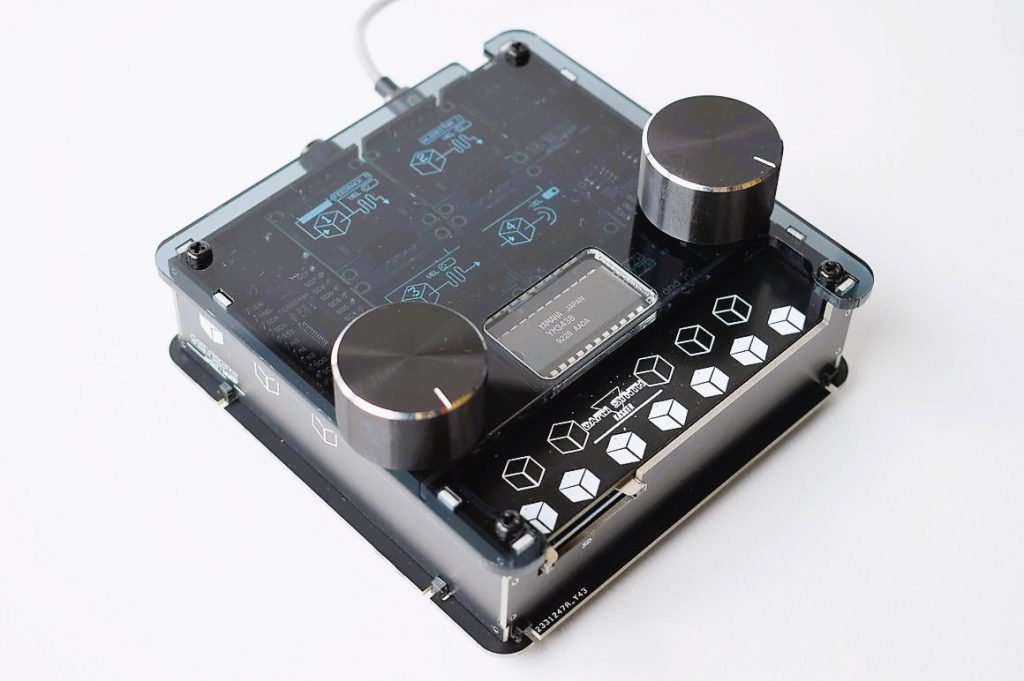
The DAFM synth GENESIS, handmade in Santander, Spain, with a Yamaha YM3438 chip under its clear acrylic window.
Why treat presets as a corpus?
Ludomusicology already listens carefully to scores, drivers and cultural context. What is still underexplored is the mountain of voice recipes sitting inside VGM logs: the ALG, feedback, TL and envelopes that composers wrote into the chip while the game ran. A VGM file is not a rendered WAV; it is a sample-accurate command stream of register writes. From that stream the community has long extracted portable OPM banks. The seed of our study is the dump DrWashington posted on KVR in February 2010: Project2612 VGMs batch-run through Shiru’s vgm2opm. We first told that discovery story in Part 1: Discovery.
Our pipeline turns those raw OPM files into an analysis-ready dataset: parse each voice (~58 chip parameters), deduplicate by timbre (ignoring TL-only volume clones), normalise game names, and enrich with composer, nationality and GEMS usage from Sega Retro, VGMrips and Wikipedia. The cleaned corpus holds 93,000+ presets. The notebooks, methodology and web app are open source on GitHub.
What the study shows
We never ask the data for genre labels. We only ask which presets look alike in YM2612 parameter space. Still, a few clear patterns emerge.
Shared YM2612 grammar. Across composers and regions, Algorithm 4 (two modulated carriers summed) and maximum feedback (FL = 7) dominate as practical defaults. Feedback itself behaves almost binary in the corpus: FL = 0 or FL = 7, with little middle ground.
Feature scores that travel. We derived a Brightness Index and a Complexity Score (both 0–1) so 58 knobs become discussable. Brightness clusters mid–high (~0.55–0.7), enough bite for small TVs and dense mixes, while Complexity sits upper–mid (~0.6–0.85).
Games leave fingerprints. Pulseman commits hard to Algorithm 5 (~75% of its presets). Gunstar Heroes, Streets of Rage 3 and Thunder Force IV spread across algorithms: identity from variety rather than from a single wiring.
Tools matter. Sega of America’s GEMS driver is a minority in our corpus (about 7.3% of presets, 43 of 547 games) but not a footnote. GEMS leans Algorithm 2 and FL = 0: industrial conditions and multi-track reliability, not “worse FM”.
Composer neighbourhoods sit inside the toolbox. Credits for Yuzo Koshiro (Streets of Rage), Masato Nakamura (Sonic), Norio Hanzawa (Gunstar Heroes) and Naoki Kodaka (Super Fantasy Zone) show recognisable habits (envelopes, routing outliers, house palettes) without rejecting the chip defaults. For more on that Japanese soundscape, see our composers post.
Those findings are hypotheses grounded in parameter space. A preset is not a full score (melody, sequencing and PCM drums live elsewhere), and today’s clustering does not yet hear the audio. Future work we sketched at Ludo2026 is exactly that: render each patch, extract audio features, and recommend by timbre as well as by knobs.
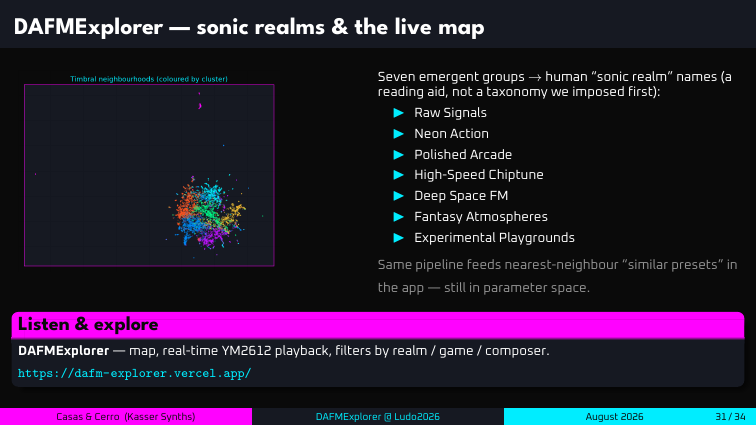
Seven sonic realms and a live map
The unsupervised path is simple to say and careful to run: compress with PCA, group with K-Means (elbow at K = 7), lay out with UMAP for a clickable 2D map. Only chip parameters enter the fit: no composer, game or genre labels. Human names come later, by listening. We call the seven emergent groups sonic realms:
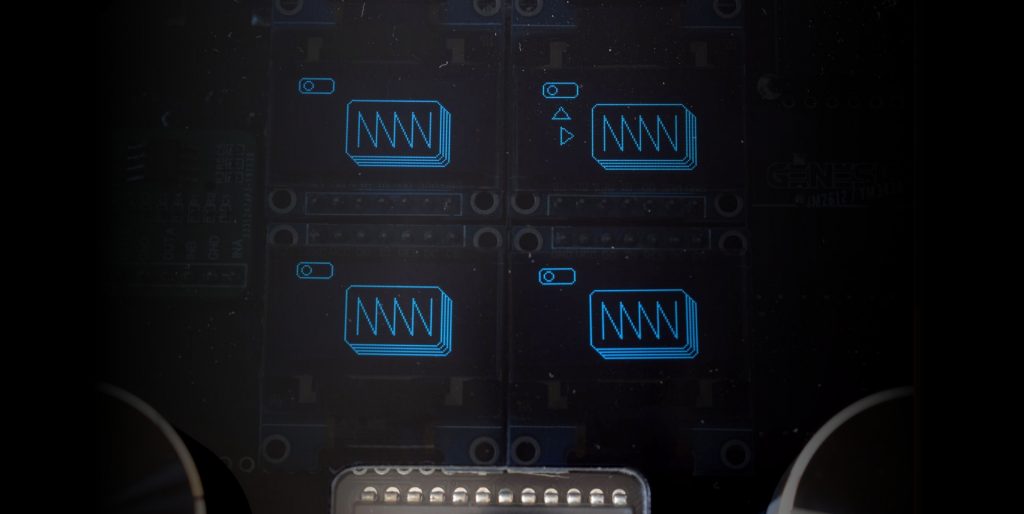
The four blue OLED operator displays of the DAFM synth GENESIS, showing the FM settings of each operator.
🎛️ From the Ludo2026 map to the real chip. Found a realm you love in DAFMExplorer? Save up to six presets, download them as a DMP file and load it from the SD card of the DAFM synth GENESIS, handmade in Santander, Spain, with your choice of the original YM2612 or the cleaner YM3438. New to DMP files? See our guide on how to load DefleMask DMP presets on hardware. Prefer to build it yourself? Grab the DIY kit. Also available at Perfect Circuit.
An invitation, not a closed paper
We brought DAFMExplorer to Ludo2026 because presets are evidence of shared timbral practice on a platform: measurable, still audible, openly reusable. The conference theme was “Pushing limits and crossing borders”; for us that border sits between listening and counting, between chiptune nostalgia and reproducible notebooks, between a Beamer slide and a Eurorack panel with a real Yamaha die.
If you want the long-form methodology, start with the DAFMExplorer post and the discovery origin story. If you want the chip under your fingers, the DAFM Genesis is waiting. And if you want to fork the corpus, the code is on GitHub: change the clustering, join another archive, or take the same pipeline to YM2151 and YMF262 next. We will keep mapping. The rest of the sonic universe is still out there.
Take the DAFMExplorer presets from Ludo2026 to the real YM2612!
Este sitio web utiliza cookies propias y de terceros para el correcto funcionamiento, análisis de la navegación y visualización por parte del usuario. Si continúa navegando, entenderemos que acepta su uso.
Se recomienda al usuario que lea atentamente esta Política de Cookies para informarse sobre el uso responsable que la página web hace de ellas y sobre las opciones que el usuario tiene para configurar su navegador y gestionarlas. Leer política de cookies
Cookies necesarias
Las cookies necesarias son absolutamente esenciales para que el sitio web funcione correctamente. Esta categoría solo incluye cookies que garantizan funcionalidades básicas y características de seguridad del sitio web. Estas cookies no almacenan ninguna información personal.
Las cookies necesarias que se utilizan en esta web son:
_PHPSESSID: Esta Cookie es usada por el lenguaje de encriptado PHP para permitir que las variables de sesión sean guardadas en el servidor web. Esta cookie es esencial para el funcionamiento del sitio web.
cmoove_gdpr_popup: Cookie técnica y necesaria que contiene el valor de si se ha aceptado la política de cookies.
mfn-builder: Esta cookie técnica y necesaria es usada por el tema de la web para cargar los contenidos de manera estructurada.
Si desactivas estas cookies no podremos guardar tus preferencias. Esto significa que cada vez que visites esta web tendrás que activar o desactivar las cookies de nuevo.
Cookies no necesarias
Cualquier cookie que no sea particularmente necesaria para que el sitio web funcione y se use específicamente para recopilar datos personales del usuario a través de análisis, anuncios y otros contenidos integrados se denominan cookies no necesarias. Es obligatorio obtener el consentimiento del usuario antes de ejecutar estas cookies en su sitio web.
Las cookies no necesarias que se utilizan en esta web son:
_ga: se utiliza para distinguir los usuarios que acceden al sitio web.
_ga_*: se utiliza para generar datos estadísticos acerca de cómo utiliza el usuario el sitio web.
¡Por favor, activa primero las cookies estrictamente necesarias para que podamos guardar tus preferencias!