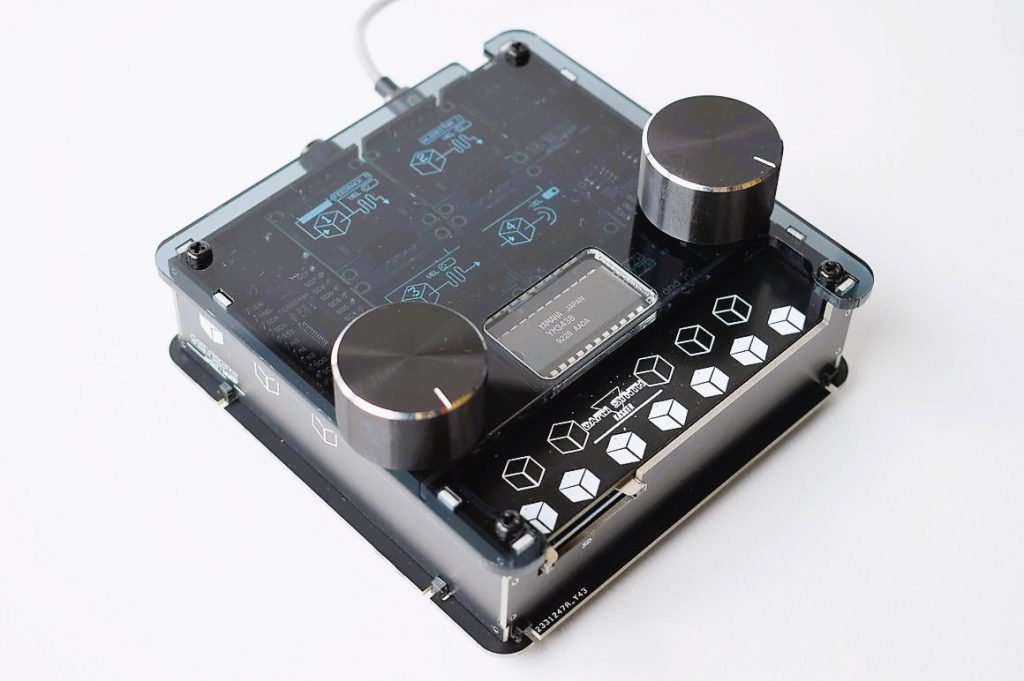
YM2612 vs YM3438: The Ladder Effect Explained (And Which Chip to Choose for Your DAFM Genesis)
Play the same Sonic bassline on an early Mega Drive and on a late-model Genesis and you may notice something odd: the notes are identical, but the sound isn’t. One is gritty, a little buzzy, and full of life in the quiet bits. The other is cleaner, louder and more polished. The reason has a name that every Sega sound nerd knows — the ladder effect — and it is the single biggest difference between the two chips you can choose for your DAFM synth GENESIS: the original YM2612 and its CMOS sibling, the YM3438.
In this post we explain what the ladder effect actually is, how the YM2612 vs YM3438 debate plays out in real music, and how to pick the right chip for the way you make sound.
The YM2612 (OPN2): the Voice of the Mega Drive
The Yamaha YM2612, also known as OPN2, is a member of Yamaha’s OPN family of FM chips and was developed as a stripped-down version of the YM2608. It is the FM heart of the Sega Mega Drive/Genesis, and it also found a home in Fujitsu’s FM Towns computers. If you want the bigger picture of how Yamaha FM defined a whole era, have a look at our post FM Synthesis: Shaping the Sound of the ’80s and ’90s.
Here’s what the chip gives you:
Six FM channels, each with four operators.
Eight algorithms that define how the operators modulate each other.
ADSR-style envelopes, operator feedback, a global LFO for vibrato and tremolo, and the quirky SSG-EG envelope modes.
Per-channel stereo (left, right or centre) and a built-in DAC — unusual for a Yamaha FM chip of its time, since most needed a separate DAC chip.
That built-in DAC is where our story really begins.
The Ladder Effect, Explained
The YM2612’s on-chip DAC is a 9-bit converter that uses time-division multiplexing: rather than summing the six channels, it outputs one channel’s sample after another in rapid sequence. Because of a design error in the original chip, this DAC introduces a peculiar form of crossover distortion around the zero point of the waveform. Signals that are quiet enough get an exaggerated, stair-stepped quantization — which is exactly why fans started calling it the «ladder effect». The nickname comes from the shape of the waveform as seen in a late-2000s forum discussion about making emulators more accurate. You will also see it called «low-volume distortion» or «TDM distortion».
What does it sound like in practice?
Quiet sounds get brighter and louder, while the loudest sounds are barely affected. Soft notes, tails and fades carry an extra buzzy «edge».
Fade-outs change character: as the music fades, the timbre shifts before it disappears.
The noise floor goes up, and on effects like tremolo the distortion can really stand out.
Because the DAC multiplexes the channels, the distortion is added per voice, not to the final mix — so it colours each part of an arrangement individually.
Here’s the twist: composers worked with this «bug», not against it. Some games released early in the console’s life, such as After Burner II, were written around the distortion to get particular timbres and effects. Play that music on hardware without the ladder effect and parts of it can sound too quiet. For many retro gamers, the ladder effect isn’t a defect at all — it’s simply what the Mega Drive sounds like.
Enter the YM3438 (OPN2C): the Clean CMOS Sibling
The YM3438, a.k.a. OPN2C, is a modified CMOS version of the YM2612. It speaks the same FM language — same channels, operators and algorithms — but it has an improved built-in DAC that significantly reduces the crossover distortion and offers a higher signal-to-noise ratio. Sega used it on various arcade boards, and Fujitsu used it in the FM Towns Marty. Later revisions of the Mega Drive/Genesis went one step further and integrated a YM3438 core directly into a custom ASIC, which is why many later consoles sound noticeably cleaner than an early Model 1.
One practical detail: the YM3438 is not a straight drop-in replacement for the YM2612 at the circuit level, because its outputs have a higher impedance. That’s one of the reasons the DAFM synth GENESIS is designed and offered for either chip.
Want to hear the difference on real consoles? This side-by-side comparison plays the same game music through a YM2612 and a YM3438 recorded from actual Genesis Model 1 systems:
Video: «Sega 2612 vs discrete 3438 in Sega Genesis – A Sound comparison» by Ivory Tower Collections (YouTube)
YM2612 vs YM3438 at a Glance
YM2612 (OPN2)
YM3438 (OPN2C)
FM engine
6 channels × 4 operators, 8 algorithms
6 channels × 4 operators, 8 algorithms
Ladder effect
Yes — crossover distortion on quiet signals
Significantly reduced (no «ladder effect» in practice)
Output character
Gritty, buzzy, «Model 1» attitude
Louder, cleaner, higher signal-to-noise ratio
Where you heard it
Original Mega Drive/Genesis, FM Towns
Sega arcade boards, FM Towns Marty; as an ASIC core in later Genesis revisions
Best for
Authentic retro grit, nostalgic tones
Clean FM sound design and production
Which Chip Should You Choose for Your DAFM Genesis?
When you order a DAFM synth GENESIS you can choose the YM2612 or the YM3438. Our own rule of thumb is simple: nostalgic retrogamers usually go for the noisier YM2612; FM-synthesis lovers usually go for the YM3438. Let’s break that down a bit.
Choose the YM2612 if…
You want the sound you remember from your first console, warts and all.
You make chiptune or game-inspired music and want that thick, twangy Genesis character on basses and leads.
You love how soft notes and fades get that extra buzzy edge — the ladder effect is part of your palette.
Choose the YM3438 if…
You see the DAFM as a compact FM synth first and a nostalgia machine second.
You want a louder, cleaner signal to process with effects, layer in a mix or record for modern productions.
You program smoother, more «instrument-like» patches where low-level grit would get in the way.
As one DIY builder put it in a review on Tindie, the 2612 has «that thick twangy classic Genesis/Megadrive sound everyone loves», while the 3438 is «much smoother and purer sounding». Both are the real thing — it’s a question of flavour.
Can’t decide? Go for the DAFM synth GENESIS DIY kit: in its latest version, the YM2612 and YM3438 can be swapped easily, so you can try both personalities on the same board. And whichever chip you pick, there’s an option to dim the OLED displays to reduce noise at the sound output (hold the left switch and press the right switch).
🎛️ Pick your chip at checkout. The assembled DAFM synth GENESIS is handmade in Santander, Spain, with your choice of YM2612 or YM3438. Prefer to build it yourself? Grab the DIY kit. Also available at Perfect Circuit.
Same Patches, Two Personalities
Because both chips share the same FM engine, a patch is a patch: everything you build on one plays on the other. The DAFM synth GENESIS ships with more than 30 presets in bank 0 taken from iconic Mega Drive/Genesis games — Sonic the Hedgehog 1, 2 and 3, Streets of Rage 1 and 2, ToeJam & Earl in Panic on Funkotron, Ecco the Dolphin, Thunder Force IV and more. Try the Streets of Rage 2 basses on a YM2612 and then on a YM3438 and you’ll hear exactly what this article is about. (Curious about the people who wrote those tracks? Read The Soundscape of Sega Genesis: Japanese Composers Who Defined an Era.)
Your own sounds can be saved to the synth’s memory or to an SD card as DMP files — the same preset format used by trackers like DefleMask. That means you can move instruments between your computer and real hardware. We walk through the whole process step by step in our upcoming guide to loading DefleMask DMP presets on a hardware YM2612 synth. And if you want thousands of Genesis-era sounds to start from, explore our open-source DAFMExplorer, which maps 93,000+ presets and lets you download them as DMP files.
Here’s the DAFM synth GENESIS in action:
DAFM SYNTH Genesis // Promo Video (Kasser Synths on YouTube)
The Verdict: Grit or Shine?
There’s no «better» chip in the YM2612 vs YM3438 debate — only the one that fits your music. The YM2612’s ladder effect is a happy accident that a generation of composers turned into a signature sound. The YM3438 takes the same FM engine and gives it a cleaner, louder voice. Pick the grit, pick the shine, or build the DIY kit and swap between them. Either way, you’ll be playing the genuine Yamaha silicon that powered the Mega Drive, not an approximation.
The DAFM synth GENESIS board, designed for either the YM2612 or the YM3438.
Choose your chip and bring the Mega Drive sound to your studio!
Este sitio web utiliza cookies propias y de terceros para el correcto funcionamiento, análisis de la navegación y visualización por parte del usuario. Si continúa navegando, entenderemos que acepta su uso.
Se recomienda al usuario que lea atentamente esta Política de Cookies para informarse sobre el uso responsable que la página web hace de ellas y sobre las opciones que el usuario tiene para configurar su navegador y gestionarlas. Leer política de cookies
Cookies necesarias
Las cookies necesarias son absolutamente esenciales para que el sitio web funcione correctamente. Esta categoría solo incluye cookies que garantizan funcionalidades básicas y características de seguridad del sitio web. Estas cookies no almacenan ninguna información personal.
Las cookies necesarias que se utilizan en esta web son:
_PHPSESSID: Esta Cookie es usada por el lenguaje de encriptado PHP para permitir que las variables de sesión sean guardadas en el servidor web. Esta cookie es esencial para el funcionamiento del sitio web.
cmoove_gdpr_popup: Cookie técnica y necesaria que contiene el valor de si se ha aceptado la política de cookies.
mfn-builder: Esta cookie técnica y necesaria es usada por el tema de la web para cargar los contenidos de manera estructurada.
Si desactivas estas cookies no podremos guardar tus preferencias. Esto significa que cada vez que visites esta web tendrás que activar o desactivar las cookies de nuevo.
Cookies no necesarias
Cualquier cookie que no sea particularmente necesaria para que el sitio web funcione y se use específicamente para recopilar datos personales del usuario a través de análisis, anuncios y otros contenidos integrados se denominan cookies no necesarias. Es obligatorio obtener el consentimiento del usuario antes de ejecutar estas cookies en su sitio web.
Las cookies no necesarias que se utilizan en esta web son:
_ga: se utiliza para distinguir los usuarios que acceden al sitio web.
_ga_*: se utiliza para generar datos estadísticos acerca de cómo utiliza el usuario el sitio web.
¡Por favor, activa primero las cookies estrictamente necesarias para que podamos guardar tus preferencias!