Two Yamaha FM chips shaped how a generation heard games, and they still shape how a lot of us write music today. The YM2151 (OPM) powered arcade boards and the Sharp X68000. The YM2612 (OPN2) powered the Sega Mega Drive / Genesis. Both are four-operator FM engines with the same eight algorithms, yet they do not sound the same. If you are deciding between a DAFM Arcade and a DAFM Genesis, this is the comparison that matters.
In this post we break down YM2151 vs YM2612: OPM vs OPN2, channels and extras, and the hardware difference that colours everything else, the DAC.
OPM vs OPN2: Same FM Family, Different Jobs
Yamaha grouped its four-operator chips into families. The YM2151 is the flagship of the OPM line (FM Operator Type-M). The YM2612 sits in the OPN line as OPN2, a lower-cost relative of the bigger YM2608. On paper they share a lot: sine operators, envelopes, feedback, and eight algorithms shared across OPM and OPN. In practice the feature sets diverge, and so does the way each chip turns digits into voltage.
Where you heard them tells the story. The YM2151 showed up on countless mid-to-late 1980s arcade boards (Atari System 1 titles such as Marble Madness, Sega boards behind OutRun and After Burner II, Capcom, Konami and more), plus Sharp’s X1 Turbo and the beloved Sharp X68000 in Japan. The YM2612 became the FM heart of the Sega Mega Drive / Genesis and also appeared in Fujitsu’s FM Towns. Same company, same FM language, two very different rooms.
The DAC Difference: YM3012 vs Ladder Effect
Here is the detail every synth player notices first: how the chip gets to analog.
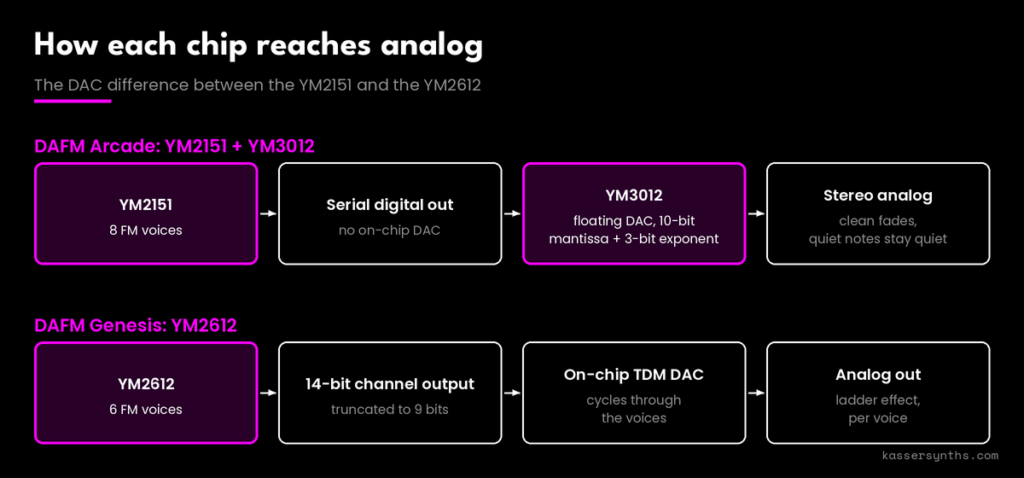
The YM2151 does not include an on-chip DAC. It streams serial digital audio to Yamaha’s companion YM3012, a two-channel floating DAC with a 10-bit mantissa and a 3-bit exponent (16-bit dynamic range on the datasheet). That split is intentional. You get a clean stereo analog path, and on the DAFM Arcade a real YM2151 always sits next to a real YM3012. Quiet notes stay quiet, fades stay smooth, and there is no per-voice stair-step grit baked into the mixer: the clearer “arcade” character of OutRun pads and Street Fighter leads.
The YM2612 took the cost-cutting route. Instead of the accumulator-style mixer of its bigger OPN cousins, it uses a time-division multiplexed on-chip DAC that truncates each channel’s 14-bit output to 9 bits and cycles through the voices. That truncation produces a polarity-dependent glitch around zero crossings: the famous ladder effect. Soft notes get brighter and louder, fade-outs change timbre before they vanish, and the colour is applied per voice. Composers wrote around it; some early Mega Drive scores lean on that grit on purpose. For YM2612 vs the cleaner CMOS sibling YM3438 (OPN2C), see YM2612 vs YM3438: The Ladder Effect Explained.
Takeaway: YM2151 + YM3012 = cleaner FM.YM2612 = classic Mega Drive attitude, ladder and all (or pick a YM3438 on the DAFM Genesis if you want OPN2 without that distortion).
Channels, Noise, PCM and LFO
Beyond the DAC, the toolkits diverge:
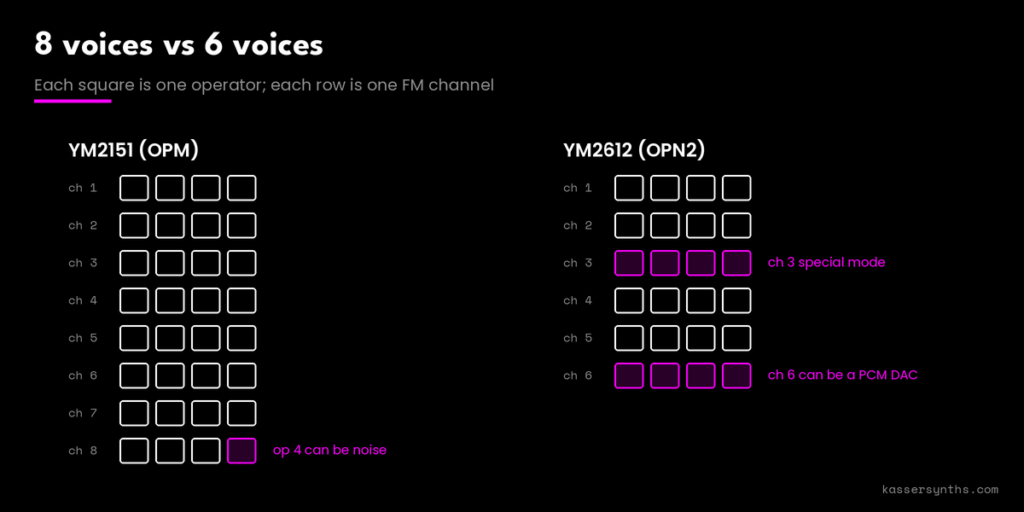
Polyphony: YM2151 has 8 FM channels × 4 operators. YM2612 has 6 FM channels × 4 operators. Two extra voices matter when you stack chords and leads.
Noise (OPM): on the YM2151, operator 4 of channel 8 can become a variable-frequency noise generator for hats, scrapes and FX.
PCM / DAC channel (OPN2): on the YM2612, channel 6 can become an 8-bit software-timed PCM DAC (register $2A, enable $2B). Classic Mega Drive drums live here; timing is entirely on the host CPU.
LFO: OPM’s LFO is more configurable (saw, square, triangle, sample-and-hold noise, plus AM/PM depth). OPN2’s LFO is simpler: global enable, fixed rates, per-channel AMS/PMS.
OPN-only extras: YM2612 keeps SSG-EG envelope shapes and channel 3 special mode (independent operator frequencies, plus CSM). OPM does not.
Detune and timers: OPM adds secondary detune (DT2) that OPN2 lacks. Both chips include hardware timers.
Reach for the YM2151 when… you want eight voices, polished arcade tone (epianos, airy pads, cutting brass without low-level buzz), clean fades, hardware noise and a flexible LFO.
Reach for the YM2612 when… you want the Mega Drive / Genesis voice including ladder colour, the channel-6 PCM path for drums, SSG-EG or channel-3 special mode, and that slightly buzzy Model 1 edge on basses and leads.
Neither is “better.” One is arcade clarity with more polyphony. The other is console grit with PCM tricks. Plenty of players own both and pick by track.
🕹️ Real chips, no emulation. The DAFM Arcade pairs a genuine Yamaha YM2151 with its YM3012 DAC. The DAFM Genesis lets you choose YM2612 or YM3438. Both are handmade in Santander, Spain, with the chip included (kit or assembled). Full lineup on Products.
How DAFM Uses Each Chip
On the DAFM Arcade YM2151 synth, the YM2151 and YM3012 are first-class citizens: eight FM voices, stereo from the floating DAC, and the OPM feature set of classic arcade scores. Bank 0 ships with presets from titles such as Street Fighter 2, OutRun, Shinobi, Golden Axe and Marble Madness, and you can save your own sounds as DMP files on an SD card.
On the DAFM Genesis, you get the OPN2 engine with YM2612 (ladder character) or YM3438 (cleaner CMOS path). Same MIDI-friendly workflow and DMP / DefleMask-friendly presets, different colour. That is why our ladder-effect article focuses on Genesis chip choice, while this one helps you choose between the two product lines.
Here is the DAFM Arcade DIY kit from our own channel, walking through the menu on real YM2151 hardware:
DAFM synth ARCADE YM2151 DIY KIT · MENU 6/6 (Kasser Synths on YouTube)
The Verdict: Arcade Clean or Mega Drive Grit?
Choose the YM2151 for eight voices and the cleaner path of a separate YM3012 DAC: arcade FM, X68000 nostalgia, pads that stay polished when they get quiet. Choose the YM2612 for six voices of Mega Drive FM, the ladder effect’s attitude, and that optional PCM channel. Or put both on the desk. The DAFM range exists so you can play the real silicon, not an approximation. Shipping notes for Japan: Japan · 日本のお客様へ.
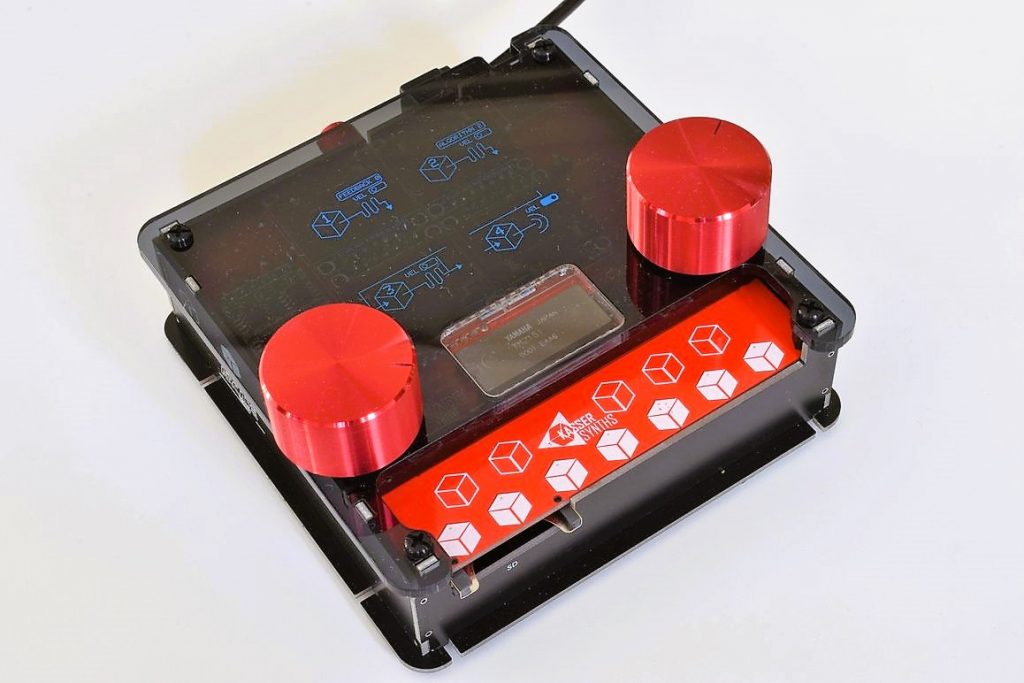
DAFM Arcade board detail: the YM3012 DAC sits beside the YM2151 path, the hardware reason arcade FM sounds cleaner than the Mega Drive’s integrated DAC.
Play real arcade FM: YM2151 + YM3012 on your desk!
Este sitio web utiliza cookies propias y de terceros para el correcto funcionamiento, análisis de la navegación y visualización por parte del usuario. Si continúa navegando, entenderemos que acepta su uso.
Se recomienda al usuario que lea atentamente esta Política de Cookies para informarse sobre el uso responsable que la página web hace de ellas y sobre las opciones que el usuario tiene para configurar su navegador y gestionarlas. Leer política de cookies
Cookies necesarias
Las cookies necesarias son absolutamente esenciales para que el sitio web funcione correctamente. Esta categoría solo incluye cookies que garantizan funcionalidades básicas y características de seguridad del sitio web. Estas cookies no almacenan ninguna información personal.
Las cookies necesarias que se utilizan en esta web son:
_PHPSESSID: Esta Cookie es usada por el lenguaje de encriptado PHP para permitir que las variables de sesión sean guardadas en el servidor web. Esta cookie es esencial para el funcionamiento del sitio web.
cmoove_gdpr_popup: Cookie técnica y necesaria que contiene el valor de si se ha aceptado la política de cookies.
mfn-builder: Esta cookie técnica y necesaria es usada por el tema de la web para cargar los contenidos de manera estructurada.
Si desactivas estas cookies no podremos guardar tus preferencias. Esto significa que cada vez que visites esta web tendrás que activar o desactivar las cookies de nuevo.
Cookies no necesarias
Cualquier cookie que no sea particularmente necesaria para que el sitio web funcione y se use específicamente para recopilar datos personales del usuario a través de análisis, anuncios y otros contenidos integrados se denominan cookies no necesarias. Es obligatorio obtener el consentimiento del usuario antes de ejecutar estas cookies en su sitio web.
Las cookies no necesarias que se utilizan en esta web son:
_ga: se utiliza para distinguir los usuarios que acceden al sitio web.
_ga_*: se utiliza para generar datos estadísticos acerca de cómo utiliza el usuario el sitio web.
¡Por favor, activa primero las cookies estrictamente necesarias para que podamos guardar tus preferencias!